Your Deagle after a jump: crouch before you land and it's accurate twice as fast
Deagle Taps in CS2, at half speed. The targets stand at 500, 800, 1,100 and 1,400 units and glow red until the Deagle is accurate at their distance. First: land and stand. Then: crouched before you land. The circle around the crosshair is CS2's Dynamic Circle crosshair (Settings → Crosshair → Style): it shows your spread as it is now.
| Distance | Land and stand | Crouched before you land |
|---|---|---|
| 500 units | 672 ms | 328 ms |
| 800 units | 969 ms | 453 ms |
| 1,100 units | 1,125 ms | 547 ms |
| 1,400 units | 1,125 ms | 641 ms |
Milliseconds from landing until each target in the clip turns green.
Land a jump and stand, and the far targets stay red for more than a second. Crouch before you land, and every target is green in about half the time. We measured why on a CS2 server, tick by tick.
What happens in a jump
We had a bot jump in place with the Deagle and land, then stand still. We logged the gun's spread, CS2's own inaccuracy value, on every server tick (64 a second), from take-off until 3 s after landing.
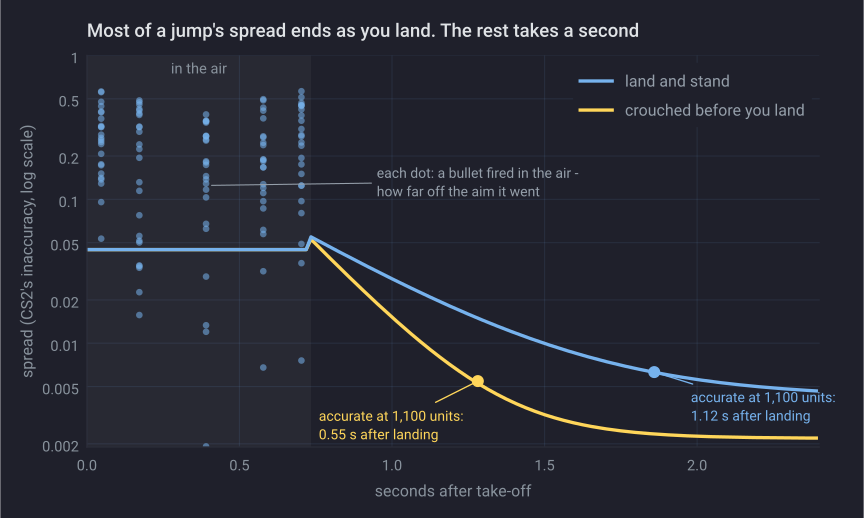
A jump, from take-off. Dots: bullets fired in the air, and how far off the aim each one went. Lines: the spread after landing, standing (blue) and crouched (yellow).
Three things happen:
- In the air, the spread is huge. Bullets fired just after take-off went up to 0.57 off the aim. At the top of the jump they still went up to 0.38. That's 90 to 135 times the standing spread.
- Landing ends most of it, but not all. On the tick you land, the air's own part is gone. The gun's penalty isn't. CS2 holds it at 0.045 for the whole jump, and landing adds about 0.012 more. You touch down with a spread of about 0.055, around 70% of what a shot leaves.
- Then it recovers as it does after a shot: tenfold every 0.81 s standing, every 0.45 s crouched.
How long after landing
We call the Deagle "accurate again" when the spread left over fits a head (about 6 units across) at the target's distance. Far away, where even a perfect first shot is wider than a head, it's when the spread is back down to within half its resting value.
| Distance | Land and stand | Crouch as you land | Crouched before you land |
|---|---|---|---|
| 500 units | 0.67 s | 0.44 s | 0.33 s |
| 800 units | 0.97 s | 0.56 s | 0.45 s |
| 1,100 units | 1.12 s | 0.66 s | 0.55 s |
| 1,400 units | 1.12 s | 0.73 s | 0.62 s |
Seconds after landing until the Deagle is accurate again.
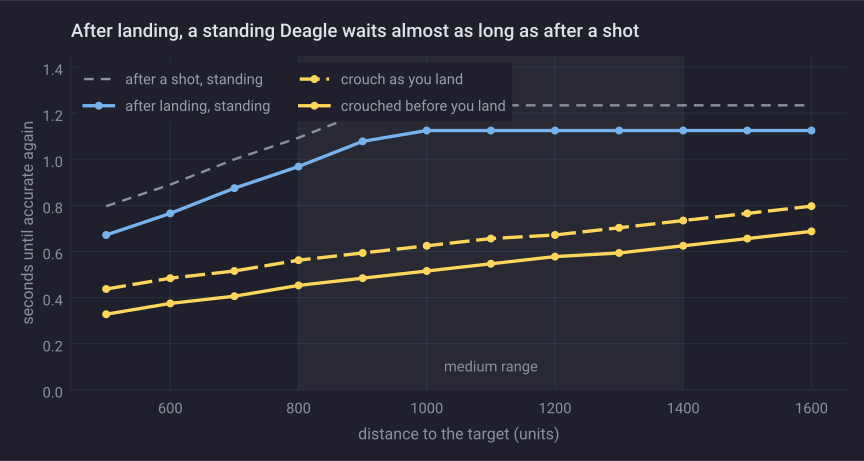
The wait after landing, beside the wait after a standing shot (dashed).
Add the 0.73 s you spend in the air, and a jump at medium range costs you 1.7 to 1.9 s before your next accurate shot.
Why it catches people out
- Landing feels like a reset. It isn't. Your Deagle still carries the jump's penalty, as if you had just fired.
- Landing makes it worse, not better. The harder you land, the bigger the extra penalty: it's your fall speed times the weapon's land inaccuracy.
- Crouching as you land works, but late. CS2 switches to the faster crouched recovery only once you're fully down, about a quarter of a second after you press crouch. Crouch in the air and the fast recovery starts on the landing tick.
- A crouch-jump doesn't help if you stand up on landing. It took 1.05 s at 1,100 units, only 0.07 s less than a plain jump.
- Standing, far targets all wait the same. From about 950 units the wait is 1.12 s whatever the distance, because there even the resting spread is wider than a head. That's why the two far targets in the clip turn green together.
The same crouch between taps
Crouching speeds up recovery after every shot too, not only after a jump. We had the bot fire single shots, standing and then crouched, and logged the spread after each one.
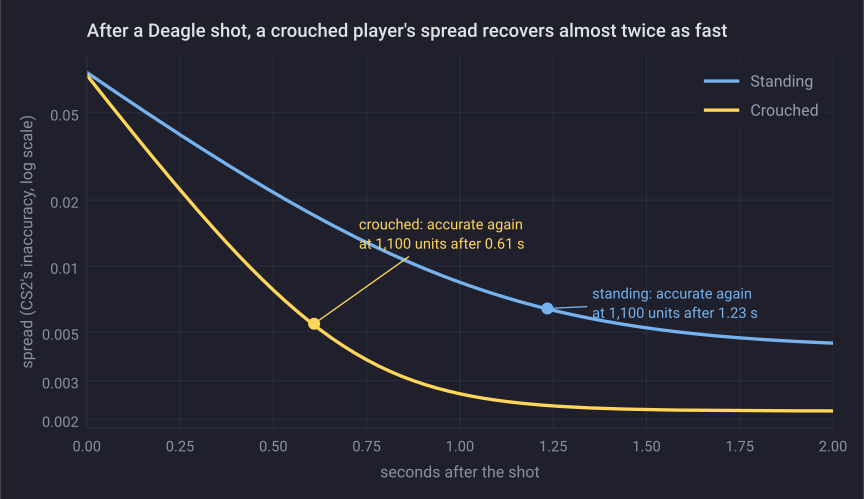
The Deagle's spread after one shot. Crouched (yellow), it falls faster and settles lower.
Two things change when you crouch:
- The spread at rest is half as big: 0.0022 crouched against 0.0043 standing.
- The spread shrinks faster after a shot: it falls tenfold every 0.45 s crouched against every 0.81 s standing.
A shot makes the spread jump to about 0.075. Here is how long until the next accurate shot:
| Distance | Standing | Crouched |
|---|---|---|
| 500 units | 0.80 s | 0.39 s |
| 800 units | 1.09 s | 0.52 s |
| 1,100 units | 1.23 s | 0.61 s |
| 1,400 units | 1.23 s | 0.70 s |
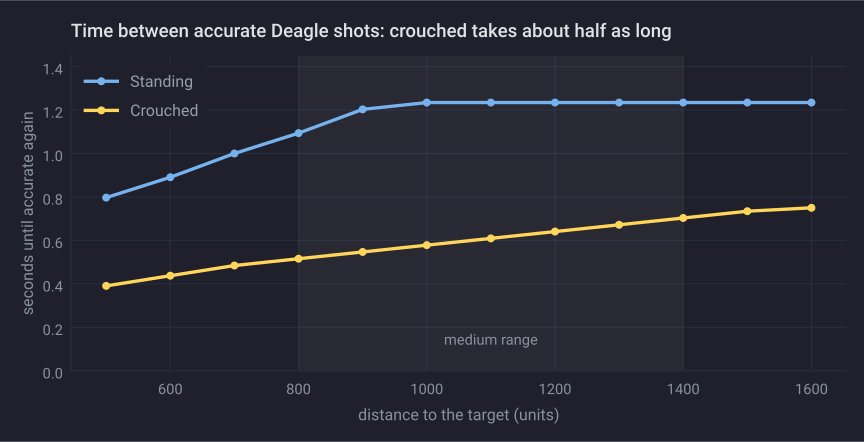
Seconds until the next accurate shot, by distance. Medium range (800-1,400 units) is shaded.
Most of the gain comes from the faster recovery. With only the tighter resting spread, and standing recovery, a crouched shot at 1,100 units would still wait 1.09 s instead of 0.61 s.
What it means in a game
- If you jump with a Deagle, crouch before you land. You're accurate again in about half the time: 0.45 s instead of 0.97 s at 800 units.
- Don't take a far shot straight off a landing. Standing, every target beyond about 950 units needs 1.12 s.
- Holding an angle at medium range: crouch. Your second accurate shot comes about 0.6 s sooner, often the difference between a one-tap and a trade.
- Crouch early. Getting down takes a moment, and recovery speeds up only while you're crouched. Crouch before the first shot, or right after it.
- Don't count on it on the move. Moving adds its own inaccuracy on top, crouched or not.
- Shooting before you're "ready" isn't a guaranteed miss. It just lowers your chance of a head-sized hit.
Practise it
In ProPeeks' Deagle Taps drill, targets glow red until your Deagle is accurate again at their distance, then green, exactly as in the clip. Jump, and every target turns red. Land, and they turn green one by one, the nearest first. Crouch before you land and watch them come back in half the time. Between shots the colour follows your stance too: crouch and the targets turn green sooner.
How we measured: a bot on a CS2 1.41.9.3 dedicated server (64 tick). Jumps: it jumped in place 10 times each way (landing standing, crouching as it landed, crouched in the air and after, and a crouch-jump), never moving sideways. We read the Deagle's accuracy penalty every tick from take-off until 3 s after landing, and counted the times from the tick it landed. To measure the spread in the air, it fired one shot per jump straight down at the floor, 12 to 27 shots at each moment, and we measured how far each bullet went from its aim. On the ground, every bullet stayed within the penalty plus the Deagle's fixed 0.002 spread. Shots: single shots, standing and crouched, never moving; the penalty read every tick for 2.5 s, times counted from the tick the shot was fired. The clip is the Deagle Taps drill on our CS2 server, with a bot standing in for the player, recorded with GOTV and played back in CS2.
It all matches CS2's weapon data for the Deagle:
| CS2's weapon data | Value | What we measured |
|---|---|---|
| inaccuracy_jump | 0.0406 | the penalty in the air: 0.0447, the standing 0.0042 plus this |
| inaccuracy_jump_initial | 0.549 | bullets up to 0.57 off just after take-off (with the penalty) |
| inaccuracy_jump_apex | 0.332 | bullets up to 0.38 off at the top of the jump (with the penalty) |
| inaccuracy_land | 0.000043 | landing added 0.0124 at a fall speed of 289 units/s: the two multiplied |
| recovery_time_stand / crouch | 0.81 s / 0.45 s | tenfold down every 0.81 s standing, 0.45 s crouched |