The fake flash in pro CS2: once in 1,776 rounds, and the turn it buys doesn't win the duel
The fake flash is one of Counter-Strike's oldest mind games. Before you peek, you throw something that looks like a flashbang: your pistol, a decoy, or (as Renegades did) the bomb. The player holding the angle turns away to save their eyes, and you walk into a free kill.
We wanted to know two things. How often do pros still do it? And when they do, does it work? We went through 91 pro demos from 2026, 1,776 rounds in all.
Where it comes from
The play that made it famous came at the ESEA Season 13 LAN in Dallas, in spring 2013. On Dust2, after the bomb was planted, it came down to a 1v1 at A between Swag (Team Dynamic) and kennyS (VeryGames). Swag threw his pistol like a flashbang and won the round. PC Gamer wrote it up, and the clip went round the community. A 2018 guide by Dignitas calls it the first fake flash in a pro match.
Players copied it with whatever looked like a flashbang in the air:
- A pistol: the classic.
- The bomb: the Australian team Renegades did it a few times, Dignitas notes.
- A decoy: it looks like a flashbang in flight. In CS:GO, only a red stripe instead of a blue one told them apart.
- A real flashbang, dropped: when CS:GO's Operation Riptide (2021) let players drop grenades, Mythic's JoJo dropped a real flashbang like a throw. It never pops. He called it the "NA Flash".
How often pros do it now
Almost never.
- Decoys: pros threw 30 in live rounds, about 1.7 per 100 rounds. Half went out in the first 10 seconds of the round, from spawn, as noise. Only 8 were seen in flight by an enemy.
- Decoy fake flashes: one. We counted a fake flash when a decoy was followed within 2 seconds by a peek at an enemy who had seen it or could hear it. It came on Inferno, on pistols, from lower Banana. Two Ts then peeked the CT at the top of Banana. He saw the decoy 10° off his crosshair, didn't turn, and fired at them. Nobody was hit.
- Pistol fake flashes: none. Our demo cache doesn't record inventories, so we went back to the raw files for 12 demos (219 rounds). There were 85 pistol drops in live rounds: gifts to team-mates, pistols picked back up, or ones left on the floor. None was followed by the thrower's team showing themselves to an enemy.
Does it still fool anyone?
Yes, about one holder in three. Here is how often a pro holder turned away within a second of seeing a grenade in flight:
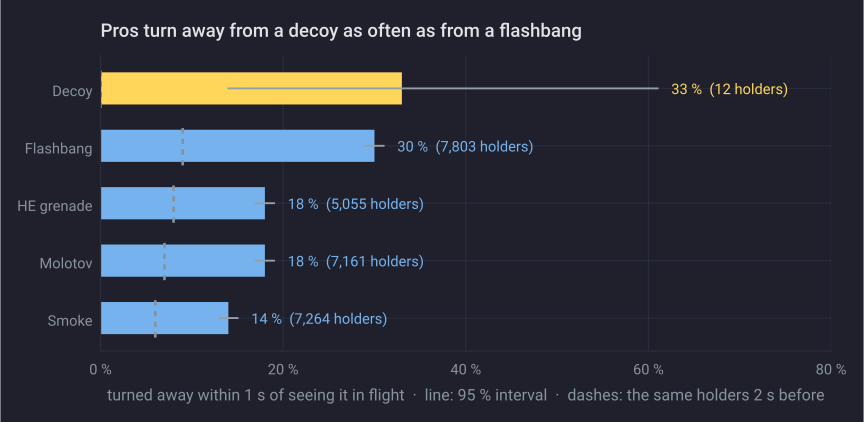
Holders in live rounds who saw the grenade in flight within 2,500 units. "Turned away": their view swung 45° or more, away from the grenade, within 1 s. The dashes are the same holders 2 s before the grenade: how often they turn anyway.
- A decoy: 4 of the 12 holders who saw one turned away (33 %), as often as from a real flashbang (30 %).
- Smokes and HEs: turned from about half as often.
- The sample is tiny: 12 decoys gives a range of 14 % to 61 %. The direction is clear, though. Pros haven't trained the reflex out.
The turns aren't instant. They come about 0.6 s after the holder first sees the grenade, and almost none within 0.3 s. Peek as you throw and the holder is still looking at you.
What the turn buys
Twelve sightings and one fake are too few to measure duels. So we looked at the closest real stand-in: 126 peeks after a real flashbang that the holder turned away from before it popped, and that didn't blind them. Except for the bang, that's a fake flash that worked. We compared each with clean peeks at the same spots, from the same side, with the same guns and distances.
| After a turn, not blinded | Clean peeks at the same spots | |
|---|---|---|
| Holder's crosshair on the peeker (within 5°) | 17 % | 50 % |
| Holder's first bullet hits | 19 % | 33 % |
| Holder's first shot | 391 ms | 297 ms |
| Peeker lands the first damage | 40 % | 49 % |
Each row compares 53 to 126 peeks with matched clean ones. The first-damage difference isn't significant.
The disorientation is real. The holder's crosshair is off you, and their first bullet comes about 0.1 s later and misses more often. But the peeker didn't land the first damage any more often. The holder is alert, turns back, and the duel is even again.
What wins duels is the blind itself. A real flashbang that blinds the holder for a second or more lets the peeker land the first damage 63 % of the time, against 47 % in matched clean peeks. A fake flash, by design, never blinds anyone.
Did it decay, or did it never really work?
We can't see the rise and fall in our data: our analysis reads CS2 demos only, so the CS:GO years are out of reach. But two things in the data point one way:
- The reflex is still there. If players had simply learned to ignore fakes, the decoy's turn rate would be far below a flashbang's. It's the same.
- The turn alone doesn't pay. Even when the holder turns, the peeker doesn't get the first damage more often.
So it looks less like a strategy that wore out, and more like one that never paid in the open. It could only ever win the moments where a turn becomes a kill on its own: a 1v1 after the plant, a holder with nowhere else to look, someone who hasn't seen it before. That's the kind of moment Swag's was. Once everyone knew about it, even those moments got rarer.
That fits what pros do now. They throw a real flashbang (6.5 per round on average) and save the decoy for noise.
What it means for your games
- Don't build your peeks on it. A decoy or a pistol costs you a moment and, at best, turns one holder in three.
- If you try it anyway, time it. Peek about 0.6-1 s after the holder can see it, while they're still turned, not as you throw.
- When you're holding: turning away from anything that looks like a flashbang is still the right reflex. The real ones blind you for a second and lose you the duel; a fake costs you about 0.1 s.
At ProPeeks we're teaching our bots to turn from grenades they see in flight, decoys included, as often as the pros do. A fake flash will fool them about as often as it fools a pro.
How we measured
- Demos: 91 pro demos from 2026: 1,776 rounds, 39,947 grenade flights.
- Who saw a grenade: an enemy of the thrower with the grenade in their field of view and a clear line to it through the map's collision mesh, not through a smoke.
- The turn: the view rotating 45° or more within 1 s, with the grenade ending up 45° or more further off the crosshair.
- Peeks and duels: from our earlier research on pro peeks.
- Matched comparisons: clean peeks at the same map places, from the same side, with the same gun class and distance band.
- Intervals: 95 %, by resampling.